Web development
How to build trust on a website that publishes data
When people rely on your numbers, trust is the product. Lessons from a prayer-times website on showing the answer first, explaining the method and admitting uncertainty.
By Zafirox Tech Team · · 2 min read
Some websites exist to publish facts people act on: prayer times, opening hours, prices, availability, delivery estimates, calculators. If a visitor cannot trust the number, nothing else on the page matters. We learned a lot about this while building AllPrayerTime.uk, a site that publishes daily prayer times for cities across the UK. These principles apply to any site where people depend on your data.
Show the answer first
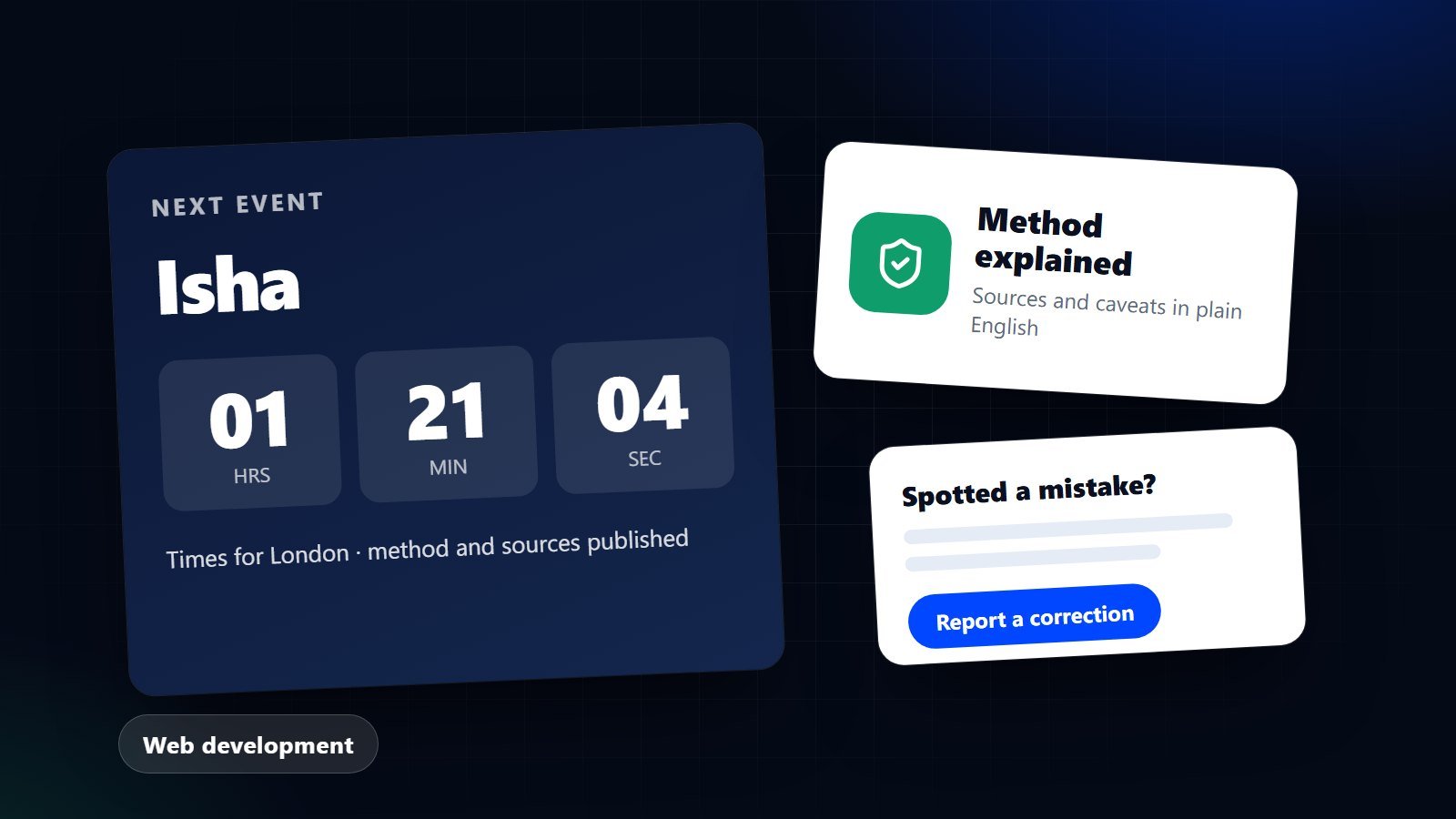
A visitor arrives with one question: "What is the next prayer, and when?" The home page answers it before anything else: the current time in the right time zone, the next event and a live countdown, followed by the full day's timetable. Work out the one question your visitors bring, and put that answer at the top of the page, not behind a menu or a marketing headline.
Explain how the number is produced
People are more willing to rely on a figure when they can see where it comes from. A dedicated methodology page that states the calculation method, the angles and offsets used, the rounding rules and how results are checked turns "trust us" into "see for yourself". If you publish prices, say what is included. If you publish estimates, say how they are estimated.
Be honest about what you do not know
Where a number has legitimate variation, say so plainly and in context. Islamic calendar dates, for example, can differ by a day depending on moon sighting, so the site labels its Hijri date as approximate. Different conventions exist for some calculations, so visitors can switch between them and read a short explanation of the difference. Uncertainty stated clearly builds more credibility than false precision.
Give people a way to tell you it is wrong
A visible corrections page and contact route show that you take accuracy seriously and give you early warning of real problems. Respond to reports, and note what changed.
Make the page work for the moment it is used
- Speed. Data people need quickly should load quickly, especially on mobile connections.
- Clear structure. Labelled blocks, consistent order and plain language reduce mistakes.
- One page per place or product. Separate pages for each city (or item) are easier to share, bookmark and find in search than one giant selector.
- Accessibility. A skip link, labelled controls and sufficient contrast matter more, not less, when the information is important.
Respect visitors' privacy and credit your sources
Ask for consent before analytics run, make rejecting as easy as accepting, and confirm that the site works the same either way. Credit images and data sources visibly. Small signals like these tell visitors the people behind the site are careful, and care is what trust is made of.
A quick audit for your own site
- Can a first-time visitor find the answer within five seconds?
- Can they see where it comes from?
- Is uncertainty explained rather than hidden?
- Is there a way to report an error, and does someone respond?
- Does the page load fast on a phone?
If your business depends on people trusting what your website says, we can help you design and build it that way. See our custom web application work or start a conversation.